Case file 001 · Open Innovation · Enterprise AI · 2026
A design system that remembers why
Shad Abbaslou · Product Design Lead · Hands-on across AI, Agents and Workflows
18 min read · 13 min skimmed · 40 slides

Case file 001 · Open Innovation · Enterprise AI · 2026
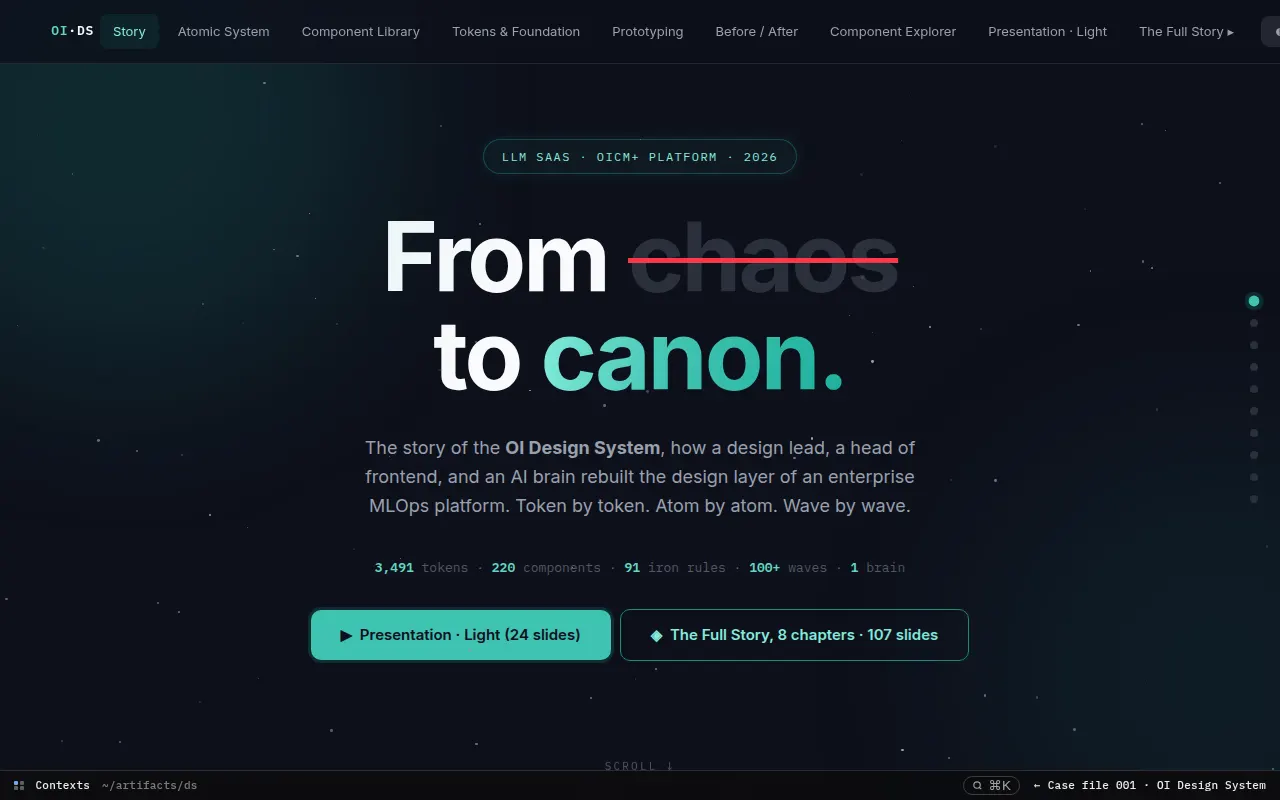
A token-governed component system, an institutional memory read by humans and AI agents alike, and a pipeline that turns plain English into working prototypes. Built as product design lead, hands-on across AI, agents and workflows, with the frontend team.
Outcome · up front
Nobody waits for a designer any more
How this is told
Two diamonds: the problem, then the answer
Each diamond opens wide and closes on one thing: the first on the problem worth solving, the second on the answer. It is the order this deck is told in, and every slide carries its phase at the top left; the case file keeps the order of the work.
The brief, in three lines
- Whatthe design system and AI prototyping pipeline of an enterprise ML platform
- Forfive product teams and nine designers
- Problemthe product ran on unconfigured Ant Design, with four heights for one bar chart
THE SYSTEM, RUNNING
A walkthrough, 21 seconds, recorded from the rebuild. The portal, tab by tab: the tokens, a theme switched, the components, the rule book in both its forms, and the decisions log. Each step is captioned as it happens, and the transcript has the same words.
Phase 1 of 4 · widenDiscover
What was actually wrong, and for whom: the evidence before any answer.
The before and after
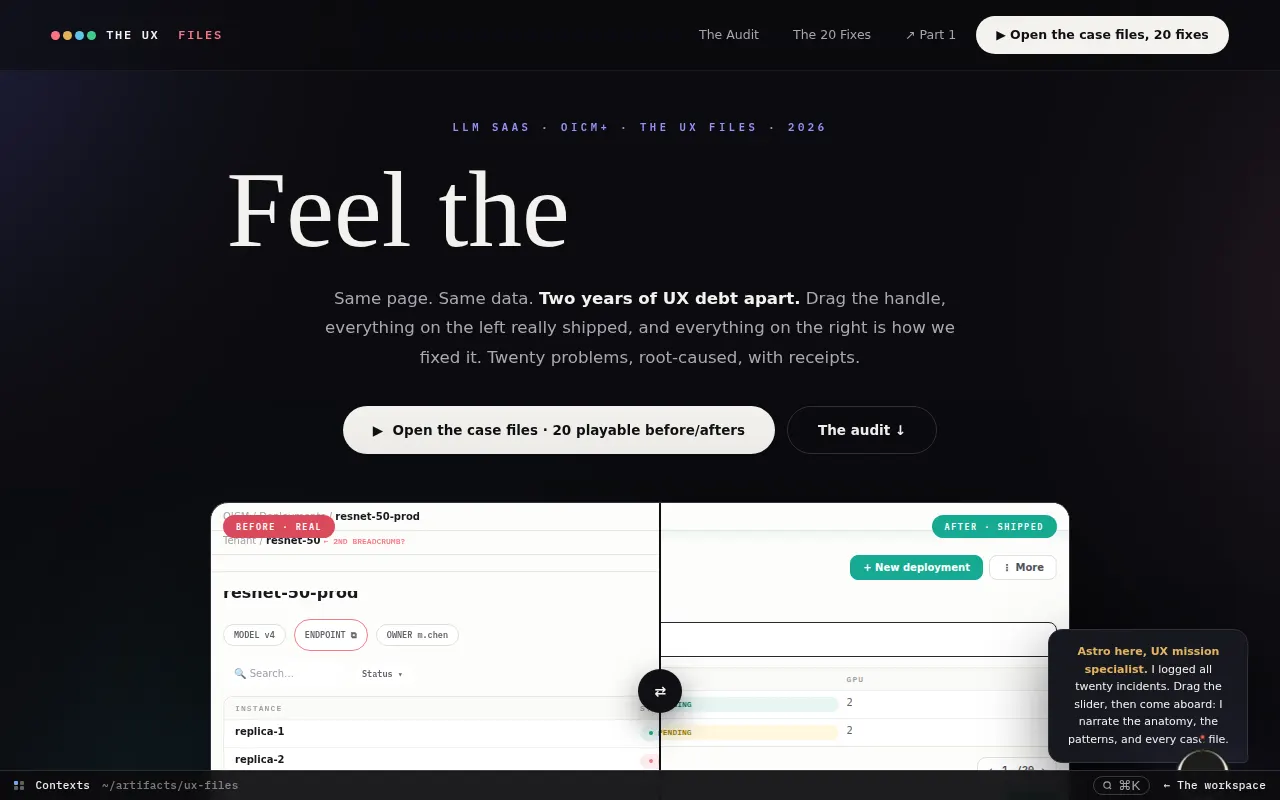
The same dashboard, two years of debt apart
We didn't rip Ant Design out, the system replaced its surface token by token, wrapping it in OI-prefixed components, so users never met a cliff-edge release.
The before and after
The honest version: the system was not the hard part. Getting engineers to want it was. That is why there are 91 numbered rules and a memory you can argue with, rather than a Figma library and a hope.
The debt, itemised, and what each fix moved
Seven things that were wrong when I arrived, the mechanism that fixed each one, and what it changed afterwards.
The platform ran on unconfigured Ant Design. One bar chart carried four control heights, one button family carried three teals, and a single Select wrapper carried !important seventy times over.
Anyone wanting to try an idea queued behind a designer, and browser-sandbox prototypes degraded into CSS imitations of the system because they could not import the production library.
Nobody could say why a decision had been made, so settled arguments reopened every few months and reversed rules crept back in unnoticed.
Design review was taste against taste, and the finished work was graded by the person who built it.
One table job was being done by dozens of near-identical implementations, ten filter patterns, eight pagination types, nine footer variants.
Layers leaked. Pages inlined spacing, molecules rebuilt atoms, and nobody agreed who owned the gap between two components.
Replacing the surface of a live enterprise product usually means one cliff-edge release that users meet on a Monday morning.
The evidence
Nothing below is a screenshot
The UX Files, 44 slides, 20 playable problems. Arrow keys work.
Phase 2 of 4 · narrowDefine
The problem narrowed to the one worth solving, and the rules any answer had to keep.
Foundations · 3,396 tokens · 6 layers
No hex
Every visual value resolves through a three-layer chain, and a component may never touch a raw value. That one prohibition is the whole trick.
Governance
91 rules, numbered like case law
Two rules were retired and their numbers stay vacant, the sequence carries its own history. Change ships as numbered waves, W11 past W110; there has never been a big-bang release.
The AI chapter
None of this hands taste to a model. The AI builds under the same constraints as any engineer, the rules, the tiers, the cold-eyed verifier, and when it refuses a request because a component doesn't exist, that refusal routes back to design as a demand signal. The last piece was teaching: an interactive atomic-design class for the whole company, public below as Everyone Builds.
The flow · end to end
A sentence goes in. Production components come out.
Phase 3 of 4 · widenDevelop
The answer drawn, tried and argued over, including the parts that were thrown away.
Foundations · 3,396 tokens · 6 layers
The chain, as the source has it
Followed from name to name until each one reaches a value, the 3,396 tokens in the stylesheets fall like this.
- 741hold a value themselves: the primitives, and the sizes and weights that need no name above them
- 1,403point at one name that holds a value
- 1,008are two steps from a value
- 233are three or more steps from a value
- 11reach a name no stylesheet in this repository declares
Foundations · 3,396 tokens · 6 layers
The Brain
A system that remembers why
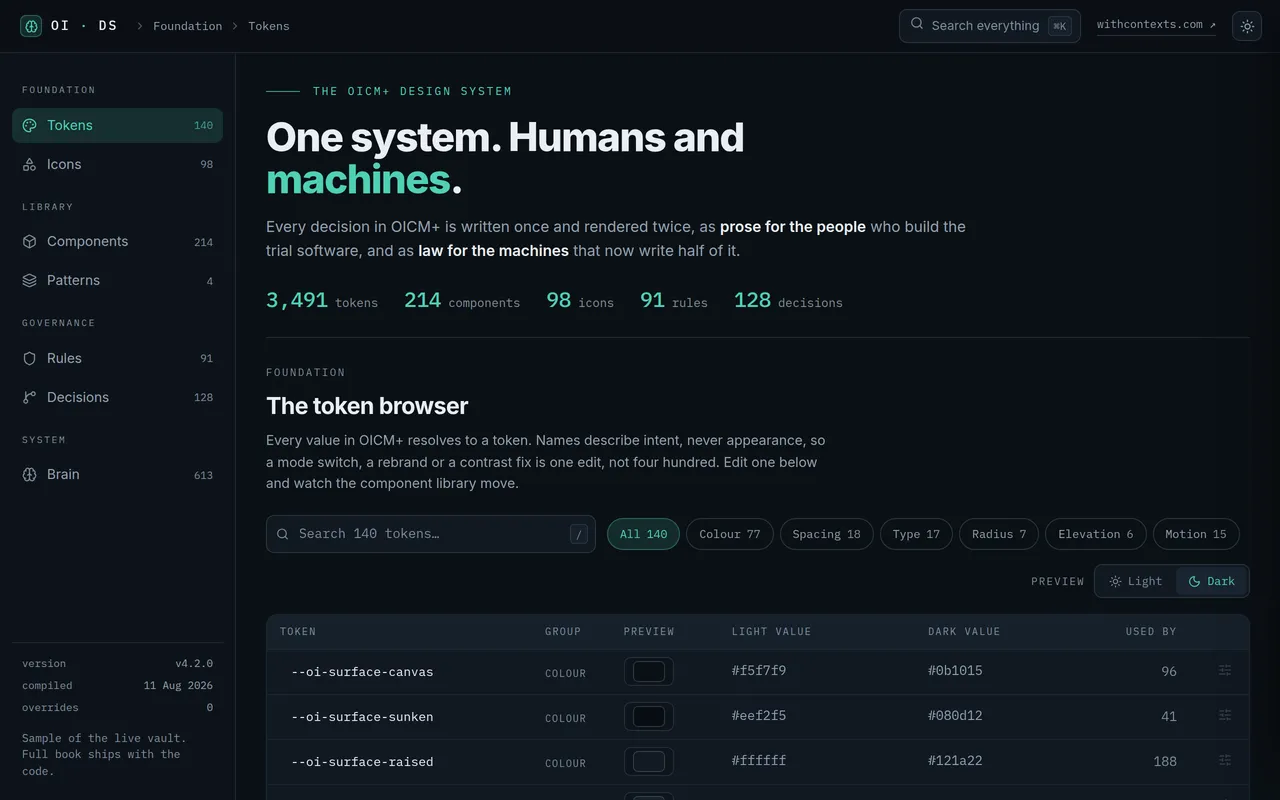
Institutional memory, treated as a product: written once, rendered twice, prose for people, structured rules for machines, so a new engineer and an AI agent read the same canon before touching a component.

The Brain
The vault itself is the one artifact this site does not serve: it holds the team roster, the full decisions log and the roadmap, and its own security note bars it from public deploys. That refusal is part of the design.
The Brain
A system that remembers why
- 1 · AskedWhy is it like this?By an engineer, a designer or an agent, before a component is touched.
- 2 · The canonRead the same rulesWritten once and rendered twice: prose for people, structured rules for machines.
- 3 · The logFind the decisionAppend-only: nothing is edited or deleted, and a reversal points at what it overturns.
- 4 · AnsweredWith a date on itThe rule’s number, the decision behind it and when it was taken.
- 5 · ChangedOnly by a new entryA rule is followed or retired in the log, and a retired number stays vacant.
Four decisions, from the log
91 rules, numbered like case law
The brain was a single contributor's notebook. Handing it to a twelve-person team meant defining and locking six roles, writing the authority matrix above, and separating the no-compile rule, which governs ad-hoc work, from CI, which does not get to skip anything.
What it cost A personal-voice scrub across the whole corpus. The writing stopped being mine, which is the point and still the part I liked least.
Page-level padding came off the canvas and into every brick, as a per-component token. The paddingInline prop came off a layout component's public API entirely.
Why Per-template opt-outs had left a hidden contract: a brick that looked right in one page template looked broken in another, and story-level migration broke every time. The fix retired two of my own earlier decisions and changed a public API, which is the expensive kind of correct.
Four decisions, from the log
91 rules, numbered like case law
Earlier that day I locked a canvas-gutter mandate across the system, hardened a rule to enforce it and added a guard grep. Hours later I reverted all three.
Why The mandate was based on a wrong reading of the architecture. Bricks carry their own padding precisely because they are the frame; a gutter on top of that compresses the content. The entry exists so that the next person to have the same idea finds out it was tried.
Five options were compared in a written strategy memo. The one already under construction was killed because its sandbox could not import the real component library, so every prototype it produced was a CSS imitation of the system rather than the system. The feedback that settled it was not diplomatic: not our components, not our style.
What the decision did not decide The model provider, export-to-TSX and authentication, each deferred in writing with a reason. A decision record that does not state its own boundaries is a decision someone else has to make again by accident.
Five routes compared in a written memo. We killed the one we were already building the day the evidence landed, and the replacement shipped in two phases. DECISION W110, THE FULL ENTRY, REASONING AND ALL, IS IN THE LOG
The AI chapter
We killed the tool we were already building
A browser sandbox can't import the production component library, so every prototype degraded into a CSS imitation of the system. The post-mortem went into the log like any other entry, and the replacement renders from the library itself.

The AI chapter
What kind of AI system it is
Not an agent left to roam: a short, fixed workflow with two checks after it, which is where Anthropic’s guidance on agents says to start.
| Pattern | Used here | Where |
|---|---|---|
| Prompt chaining | A sentence goes in, the output is rendered from the production components, and what comes out is a Storybook story in the product’s shell | The prompt, the pipeline, the story |
| Routing | To a person: when a request needs a component that does not exist, it is refused and the refusal goes to design as a demand signal | The refusal |
| Evaluator and optimizer | A fresh-context verifier grades finished work cold and cites rule numbers in what it finds; screenshots compare every visual change with the last | The verifier, the screenshot check |
The AI chapter
One prompt, read line by line
From the pipeline’s prompt library, as written; the company and the deployments in it are invented. What each line is for.
/prototype A deployments list page. Breadcrumb: Workspaces > Acme Corp > Deployments. Title "Deployments" with count badge "108 total". Subtitle "Active model deployments across all clusters". 3 KPIs: Running 84 (up 6), Pending 12 (down 2), Failed 4 (down 1). Then a 6-row table titled "All Deployments" with columns Name, Status (badge), GPUs, Replicas, Owner. Use names like llama-3-70b-prod, embedding-svc, reranker-stg, translation-en-fr, speech-to-text-test, image-gen-canary. Mix statuses.- A page type, not a picture“A deployments list page” names a kind of page the library has templates for, so the model fills slots rather than drawing a layout.
- Where it livesThe breadcrumb puts the page inside the product’s own navigation, so the story renders in the real app shell.
- Named parts, in orderHeader, then KPIs, then a table: each maps to a section type in the library, and the order is the page.
- Real-looking dataPlausible names and statuses make the prototype something a person can react to, not a page of placeholders.
- What it does not sayNo colour, no spacing, no font. Those belong to the tokens, and a prompt that set them would be asking the model to break Rule 4.
Phase 4 of 4 · narrowDeliver
What shipped, what each change moved, and what I would do differently.
What was broken · what changed · 01 of 07
The platform ran on unconfigured Ant Design. One bar chart carried four control heights, one button family carried three teals, and a single Select wrapper carried !important seventy times over.
A three-layer token chain, primitive, semantic, component, with one prohibition: a component may never read a raw value. Rule 4, no hex above the token line, fails the build rather than the review.
3,396CSS custom properties now carry every visual value, and dark mode shipped at the cost of zero component code.COUNTED FROM SOURCE · SEE THE COLOPHON
What was broken · what changed · 02 of 07
Anyone wanting to try an idea queued behind a designer, and browser-sandbox prototypes degraded into CSS imitations of the system because they could not import the production library.
A plain-English pipeline that renders from the component library itself, inside the product's own app shell, after we shipped two phases of our own playground and killed it in a day when the evidence said no.
~15 sper iteration, and roughly two dozen production-track prototypes authored by people who do not write components.DECISION W110 · THE FULL ENTRY IS IN THE LOG
What was broken · what changed · 03 of 07
Nobody could say why a decision had been made, so settled arguments reopened every few months and reversed rules crept back in unnoticed.
An append-only decisions log at the centre of the vault. Nothing is edited or deleted; a reversal is a new entry pointing at the one it overturns, reasoning attached, dated.
378 / 6,683documents and cross-links, written once and rendered twice, prose for people, structured rules for agents.COMPUTED FROM THE VAULT MANIFEST
What was broken · what changed · 04 of 07
Design review was taste against taste, and the finished work was graded by the person who built it.
91 rules numbered like case law, cited by number in review, plus a fresh-context AI verifier that grades work cold and quotes rule numbers in its findings.
The argument moved from pixels to rules: a disagreement now cites a number, looks up why it exists, and either follows it or retires it in the log. Two rules have been retired; their numbers stay vacant.FROM THE RULE BOOK
What was broken · what changed · 05 of 07
One table job was being done by dozens of near-identical implementations, ten filter patterns, eight pagination types, nine footer variants.
Wave 74 audited every consumer and rebuilt them bottom-up as a single slot-configured OITable family, rather than adding one more variant.
37 → 1table consumers now sit on one canonical organism.WAVE W74 · DECISIONS LOG
What was broken · what changed · 06 of 07
Layers leaked. Pages inlined spacing, molecules rebuilt atoms, and nobody agreed who owned the gap between two components.
A six-layer hierarchy where skipping a layer fails the build, an eight-file promotion contract, and one spacing law: atoms own their insides, never their outsides, the brick wrapper owns the gaps.
Spacing became arithmetic instead of judgement: 24 at every canvas edge, 12 between rows, by construction rather than by review.RULES 82–84
What was broken · what changed · 07 of 07
Replacing the surface of a live enterprise product usually means one cliff-edge release that users meet on a Monday morning.
No big bang. Each change shipped as a numbered wave, scoped, preservation-gated, verified, logged, wrapping Ant Design in OI-prefixed components token by token.
100+waves from W11 to W110 and counting, and no release that users had to relearn the product for.WAVE NUMBERS FROM THE LOG
Outcome
Nobody waits for a designer any more
| It worked if | Result | Status |
|---|---|---|
| No component touches a raw value | Counted in the source: 0 of the 1,304 colour declarations in the system’s component stylesheets is a hex, rgb, hsl or named colour | Met |
| Dark mode costs no component code | Shipped as a token swap; no component code was touched | Met |
| A sentence becomes a prototype without waiting for a designer | About 15 seconds from plain English to a working Storybook prototype in the production components | Met |
| A decision outlives the person who made it | Numbered rules, retired ones kept, and an append-only decisions log read by people and agents | Met |
Outcome
What I would do differently
The measure of the system is who uses it. Nobody waits for a designer to try an idea any more, a PM with a sentence of plain English gets a working prototype in the product's own components, and the design conversation moved from pixels to rules: when we disagree now, we cite a number, look up why it exists, and either follow it or retire it in the log.
- Win the engineers before the library. The system was not the hard part; getting engineers to want it was. I would put the rule book and the memory in front of them before the first component, not after.
- Read the architecture before writing a rule. I once mandated a gutter across the system, hardened it into a rule and a guard, and reverted all three hours later: bricks carry their own padding because they are the frame. The decision log keeps the entry so nobody repeats it.
- Compare the options before building one. The prototyping route that was killed was already under construction when five options were finally compared in a written memo. The memo should have come first.
Case file 001 · Open Innovation · Enterprise AI · 2026
Questions
Nobody waits for a designer any more
The other decks002 · Astrato003 · Safe Space004 · Novo Nordisk005 · JBS